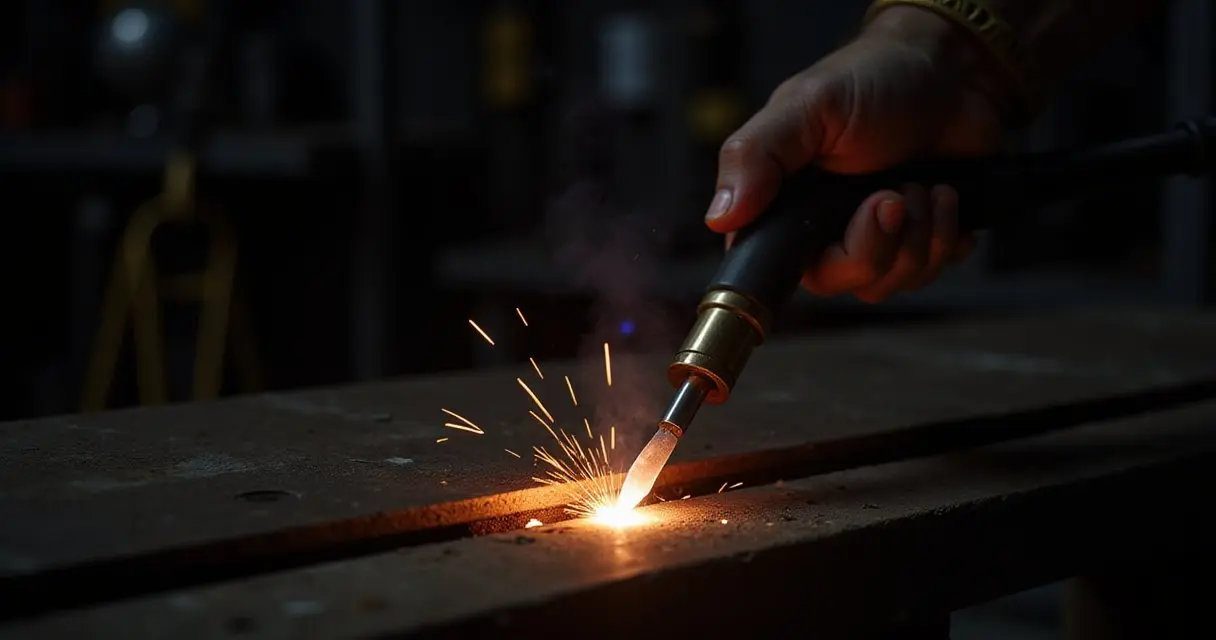
Across the country, employers are competing for welders, one of the most in-demand groups of skilled workers out there.
Construction crews, pipelines, shipyards, and factories all rely on people who know how to join metal, and many of them move fast to hire anyone who shows up ready.
It is solid pay for work that needs no college degree, and your skill travels from one employer to the next and from state to state.
Start learning to weld today
Free, self paced, and you finish with a real certificate of completion.
What used to stop people was the cost. You could spend thousands of dollars on welding school before striking your very first arc.
Getting started is a lot cheaper these days. The theory, safety, and fundamentals of welding can be learned online for free, at whatever pace your life allows.
Read on for what welding certification really means, which free courses are best to start with today, and the honest road from a free course to a paying job.
Why a welding career is worth it
Few doors into skilled trade work open as fast as welding does for someone without a degree.
The median welder earns about $51,000 a year, and the top ten percent take home over $75,000, based on Bureau of Labor Statistics figures.
Entry pay sits below that, but it rises quickly as you pick up new processes and certifications.
The reason for the steady demand is not a boom. Every year the field loses thousands of workers who retire.
According to BLS projections, there will be around 45,000 welding openings a year for the next decade, mostly to replace those workers rather than from growth.
So new welders have real and constant room to get in, even though the headline growth number is small.
Specialty work pays more still. Traveling, underwater, and pipeline welders can earn far above the median.
Just remember those jobs are the exception and not where most people begin, so the median is the honest number to plan around at first.
Where welders work and which welding jobs pay most
Think of welding as a skill rather than one job. It runs through a dozen industries, and the setting shapes your pay.
Most entry welders start in manufacturing or fabrication shops, turning out everything from trailers to structural steel.
Construction is another big employer, with welders on bridges, buildings, and heavy steel, usually for better pay and steady overtime.
The harder fields are where the big money sits. Shipyard, pipeline, underwater, and aerospace welders earn well above the median.
Those roles ask for more skill, more certifications, and sometimes travel or rough conditions in return for the pay they offer.
The plan, honestly, is not complicated. Begin in a shop, get your technique clean, and then head for the specialty that pays the way you want.
What welding certification actually requires
Confusion runs high on this subject, so here is the straight story.
What a free online course gives you is a certificate of completion, evidence that you studied the theory.
It does not equal a professional welding certification, which is the thing employers actually test for.
The main professional credential is AWS Certified Welder, from the American Welding Society.
The test generally lasts a few hours and is done in person, with real metal, measured against AWS code.
No app and no video will earn you that credential, because the skill has to be physically present.
How online welding training works, and where it stops
Online welding training takes on the portion of the work that a screen can actually teach.
Bite sized lessons cover welding processes, safety, metallurgy, and how to read blueprints and weld symbols.
Most platforms save your progress, so you can study during a break or a few nights a week without losing your place.
At the end, a certificate of completion is yours, and it looks good on a resume.
Muscle memory is outside its reach. Laying a clean bead comes only from a torch, practice, and time.
The free course is your first step, a foundation to build on, and not the finish line.
What a free welding course covers
A serious online welding course hands you the knowledge you need before ever lifting a torch. Expect lessons on:
- The main processes: MIG (GMAW), TIG (GTAW), stick (SMAW), and flux core (FCAW)
- Shop safety, protective gear, and fume and fire hazards
- Basic metallurgy and how different metals behave under heat
- Reading blueprints, weld symbols, and joint types
- Inspection basics and how to spot common weld defects
Already knowing all this when you walk in means the hands on time is spent improving, not covering the basics from scratch.
Which welding process should you learn first?
Welding has four main processes, and nobody expects you to know all of them on day one.
MIG (GMAW) is the easiest to learn and the process shops use most, so beginners usually start with it.
Quick and forgiving, MIG shows up everywhere from auto repair to general manufacturing.
Stick (SMAW) tends to follow. It holds up well outdoors and on construction sites, in wind and even on rusty metal.
TIG (GTAW) is both the hardest and the cleanest, the go-to for thin metal, stainless, and aluminum when the weld must look perfect.
MIG builds your confidence; stick and TIG can come later, when the jobs you want start to demand them.
Best free and low cost welding courses
Every course listed below is real, and we are honest about which parts are free and which cost money.
No platform on this list certifies you to weld professionally. What they offer is theory and fundamentals.
| Platform | Cost | Format | Best for |
|---|---|---|---|
| Alison | Free | Web course | A free, reputable course with a completion certificate |
| Cursa | Free | App + web | A free course with an explicit free certificate |
| SkillCat | Free basics | App + sims | Mobile lessons with a welding safety focus |
| Lincoln Electric | Free | Videos / academy | Manufacturer training from a trusted welding name |
| AWS Learning | Paid (~$350) | Self paced + exam | An official AWS certificate and CEUs |
If you only want one place to begin, Alison's welding course is free, recognized, and comes with a certificate at the end.
How long it takes and what it costs
The quick, low cost piece is the online theory. Most free courses take a few hours to a couple of weeks, at your own pace.
Developing real skill is slower. A focused welding certificate program normally takes three months to a year.
Spending splits in the same way. You can get the theory free, but hands on work and testing are where your money goes.
Expect about $75 for the AWS Certified Welder application, plus a small fee every six months to stay active.
The weld test itself usually costs $300 to $450 at a testing facility, depending on the position and process involved.
Short on money? Explore the free paths first. Veterans and young adults can often train free with programs like Job Corps.
Can an online course replace in person welding training?
No. Most beginners overlook exactly this.
Real welding is physical, and you are judged on the quality of the weld you produce.
That ability is built at a trade school, at a community college, through an apprenticeship, or on the job in a shop.
A free course shortens the learning curve and shows initiative to a shop. It will never stand in for torch time.
Will employers accept an online welding certificate?
That comes down to what you want it to prove.
To show you understand the fundamentals and took initiative, yes, it gives your application a boost.
To replace a weld test, no. A shop is still going to want to see you weld.
Use it the honest way: study free, learn the terms and the safety, and then prove your skill in person.
And if a job calls for a particular certification, plan for the AWS Certified Welder test at an approved facility.
Red flags to watch out for
Free welding certificates get searched a lot, which brings in a handful of bad actors.
Be cautious with any site that promises an instant welding certificate with no course and no test.
Distrust pages that imply an online course equals an AWS certification or a license to weld anywhere.
And pass on anything that asks for a big upfront fee for a certificate employers do not recognize.
Trustworthy platforms state upfront that they teach only the fundamentals, and that honesty is the sign to look for.
Your next steps
Welding no longer has to begin with a big tuition bill.
Choose one free course from the list and complete the theory this week.
Next, get hands on a machine with a local class, an apprenticeship, or an entry level job in a shop.
When you are ready, set up a weld test or sit the AWS Certified Welder exam to make it official.
Taken one honest step at a time, that is how curiosity becomes a paid welding job.
Frequently asked questions
Can a welding certificate be earned online for free?
Yes. Both Alison and Cursa run free welding courses that include a free certificate of completion. Know that this certificate only proves you studied the theory, and it is not a professional welding certification.
Will an online course alone make me a welder?
No. You can learn theory and safety online, but welding is a hands on skill. Employers want real practice and, for most jobs, a passed weld test before hiring.
What is the typical welder salary in the US?
Bureau of Labor Statistics figures put the median welder at about $51,000 a year, with the bottom tenth under $38,000 and the top tenth over $75,000. Specialty and pipeline welders earn more.
Does the AWS Certified Welder test happen online?
No. You take the hands on skills test in person at an AWS Accredited Testing Facility, welding in set positions and processes that are judged against AWS code.
How long does welding certification usually take?
The theory takes from a few hours to a few weeks online, at your own pace. Developing the skill and passing a weld test typically takes months of regular practice.
Do employers recognize online welding certificates?
Yes, as a foundation and a sign of initiative. No, as a substitute for a weld test. Most shops will still watch you weld before they make a hire.
Do you need a high school diploma to begin welding?
You do not need one for a free online course. Some trade schools, employers, and apprenticeships may, so check the requirements of the program you choose.